Welcome to our blog for our trip to Europe. We start in Ireland, then go to England and finally to France. We look forward to your comments.

Tuesday, 21 August 2012

Visiting Bath and then on to Lynmouth

Day 11, Tuesday 21 August


Today on our way to Bath we went through the towns of Pucklechurch, Didmarton and Knockdown. Now I thought the Welsh had the scoop on strange and unusual names but the English rival the crazy tongue twister names with absurd and ridiculous names.

Bath

I’m sure I saw Jane Austen today; or at least her shadow in the wonderful buildings of Bath.

In Northanger Abbey Jane writes 
'They arrived in Bath. Catherine was all eager delight; - her eyes were here, there, everywhere, as they approached its fine and striking environs, and afterwards drove through those streets which conducted them to the hotel. She was come to be happy, and she felt happy already'.

The Roman baths

We walked today where Romans walked on 2000 year-old pavements beside the steaming pools of the baths. This extraordinary testament to the engineering skills and lifestyle that the Romans created to imitate life as they would have lived it in Rome.

Standing before the mysterious green waters of the great pool at Bath, overlooked by time-darkened statues of Roman emperors, you cannot help but feel transported in time, back to the days when Roman citizens and centurions bathed in this pool and offered homage to the patron goddess of the waters, Minerva. It's an illusion, of course. The familiar green hue of the pool is not the result of mystery, but of algae, caused by the water's exposure to the open air.


Roman houses had water supplied via lead pipes. However, these pipes were taxed according to their size, so many houses had just a basic supply and could not hope to rival a bath complex. Therefore for personal hygiene, people went to the local baths. The bath complex was not just about cleanliness it was also a gathering point and served a very useful community and social function.

Taking a bath was not a simple chore. There was not one bath to use in a large complex; not dissimilar to a good sports complex today. A visitor could use a cold bath (the frigidarium), a warm bath (the tepidarium) and a hot bath (the caldarium). The Bath complex also contained an exercise area (the palaestra), a swimming pool and a gymnasium.

Women would come to the baths with their slaves for beauty treatments and compare who had the best behaved slaves, the best oils and the best beauty treatments. Sound familiar?
The Roman Baths Museum contains many objects of interest, including thousands of objects thrown into the spring as offerings to the goddess. These offerings including curses.  Messages inscribed on sheets of lead or pewter that were rolled up and thrown into the spring where the spirit of the goddess dwelt. Theft was a problem in Roman bath houses, so slaves watched bathers' property and curse tablets punished those who stole.

Imagine emerging wet from a swimming pool to find your clothing gone. How would you get home? Would a kindly stranger lend you a jacket? Would you notify the police? The Romans didn't have police, but they did have something else that worked as a deterrent, the fear of the gods. In general, the tone of the tablets displayed at Bath seems excessive, out of proportion to the crime.

Try a sip of the hot mineral spring water in the Pump Room's fountain - it tastes truly awful, but has long been believed to have healing powers!

Royal Crescent in Bath. A Georgian classic.

Bath to Lynmouth

Driving through the Devon countryside this afternoon was spectacular. Imagine someone has thrown a patchwork quilt over a very lumpy bed. The fields surrounded by their hedgerows represent the patches on a quilt. The intensity and variety of greens, sit aside lush heath and fields that have been cropped and sit yellowing in the summer sun. Picture perfect.


Lynmouth is a quiet, picturesque harbour village where the rivers of the East and West Lyn join to meet the sea. Thatched white walled cottages sit crowded on the side of the clifs overlooking the very cute seaside town. It has the second highest tides in the world, which are sometimes quite spectacular. The beach (or what the English take for a beach) is a sludgy grey slop, until it reaches they grey smooth rocks that create bubbles as the waves cascade over their smooth surfaces.

Looking over the river from our B&B at low tide.
The famous Cliff Railway joins Lynmouth to its twin village, Lynton, set in a hanging valley 500 feet above. The area has for many years been known as "England's Little Switzerland" and has inspired poets including Shelley and Southey. The area has stunning unspoilt river walks, a picturesque harbour and eclectic range of great shopping from the Rye carnival experience to brilliant seafood restaurants.

Giles, our host at the Riverside Cottages B&B, is a character right out of Doc Marten. When I asked him about the dress code in the restaurant he recommended for our dinner tonight he responded: “Oh (with a Devon inflection) anything goes ‘ere. Yer need clothes though.” I’m thinking he means relaxed casual.

On the pier at Lynmouth.


To Oxford and wandering the Cotswalds

Day 10, Monday 20 August


On the way to Oxford - Cirencester

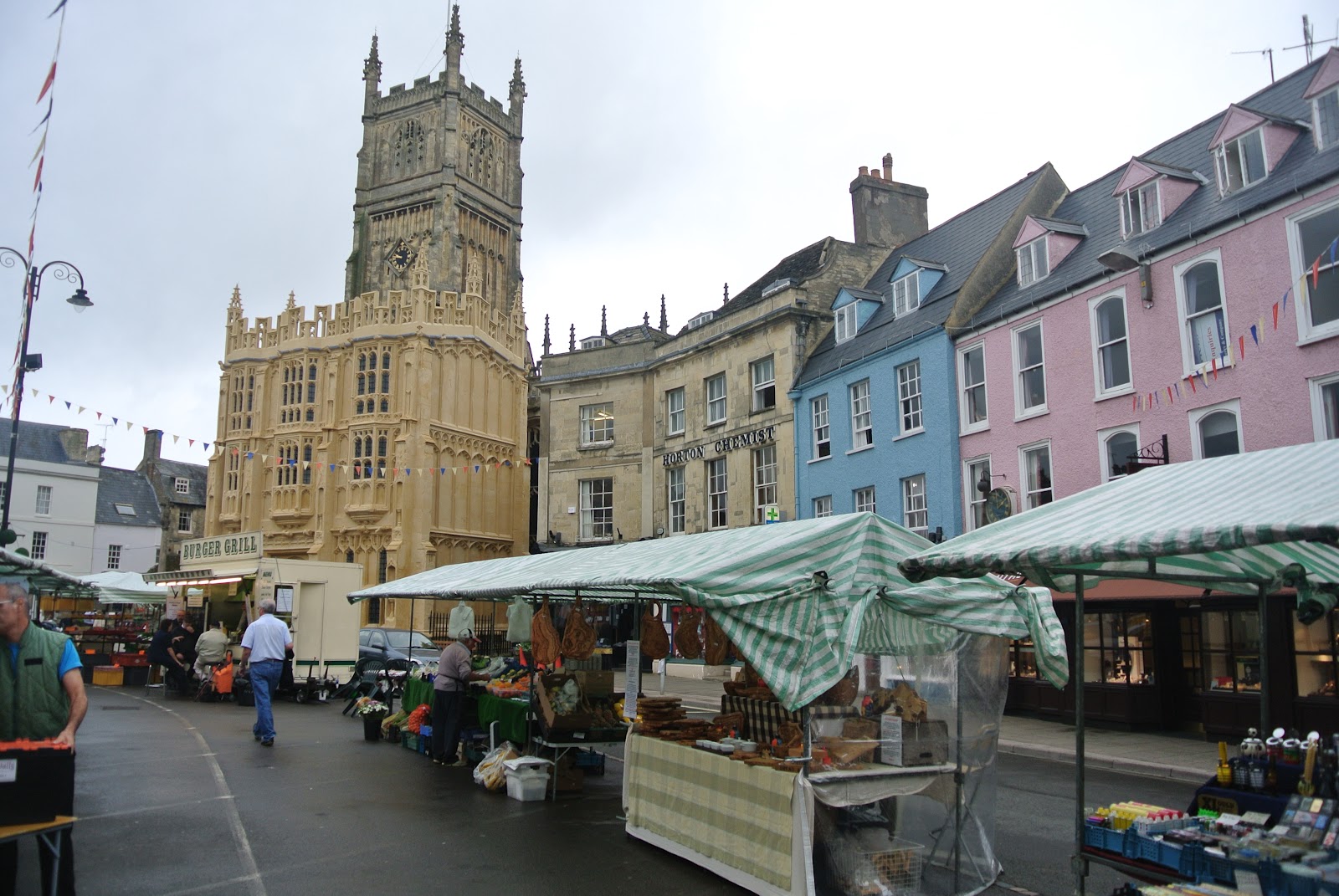
Monday is market day in Cirencester – so we arrived in time to pick up some good deals at a Moroccan stall!!! The woman who ran the stall, lives in Morocco, buys her goods there and brings them back to good old England to sell them at a handy profit.

Cirencester, known as the "Capital of the Cotswolds", is an historic Roman town in the heart of the Cotswolds with attractions from a Roman Ampitheatre to the nearby Chedworth Roman Villa. We settled for a walk around the centre of the town and the market stalls before heading off to Oxford.


Oxford

The day was interesting before it had really started. We had fully intended parking the car outside Oxford and catching the bus into town. Somehow we managed to be inside the city before we knew it. So we ditched Plan A and moved directly into Plan B, park the car and walk. And walk we did not just once around Oxford but twice. You might well ask why, but that story is for another time.

First stop Christ College

Christ College is a working academic and religious institution and some areas, including the Hall and the Cathedral, sometimes close without notice. This twelfth century church is amongst the oldest buildings in Oxford, and one of the smallest Anglican cathedrals in England. It is also the only church in the world to be both a cathedral and a college chapel.


Christ College (also known as ‘The House’) was founded in 1525 by Cardinal Thomas Wolsey, and was originally called Cardinal's College. In 1546 Henry VIII took it over and renamed it Christ College. This college is the largest of all Oxford's Colleges. In the middle of the College lies Tom Quad, the largest quadrangle in Oxford; a beautiful manicured space of green lawn with welcoming signs saying – ‘keep off the grass’.


Tom Tower was dedicated to Thomas of Canterbury. The upper section of the tower was designed by Sir Christopher Wren in 1682. The 7-tonne bell in the tower chimes 101 times each night at 9:05pm, the time when the original 101 students were called back for curfew. Since Oxford is 5 minutes west of Greenwich, this is actually 9pm Oxford time.

The Great Hall (the college dining hall) was closed for the students lunch when we first visited so we came back again later and it was open and set up for the dinner session. It will look familiar to any fans of the Harry Potter films, as it inspired the set of Hogwarts dining hall. Scenes from the movie were filmed there, and on the grand stairs leading to the Hall. It is easy to imagine Harry standing up from the dinner table and making one of his very Potterish speeches in front of the witches and wizards in training at Hogwarts.


Christ College has produced 13 British Prime Ministers in the last 200 years. That's more Prime Ministers than were produced from any other college in Oxford, or by the whole of Cambridge University!

There are many other buildings worth visiting while in Oxford. Some are associated with the University, and some are not, but most of them are old and fascinating and are definitely photo-worthy. I was particularly captivated by the Bridge of Sighs. Officially known as Hertford Bridge, it is more often called the Bridge of Sighs because of the similarity to the famous bridge in Venice. It was never intended to be a replica of any existing bridge. It was completed in 1914 to connect two sections of Hertford College.


On our second lap around the city, we navigated the streets of Oxford with conviction looking for the Old Fire Station. Found it – or at least we found the spot where it used to be, which has been turned into a cafĂ©. To soften our disappointment were felt justified in ordering two ice-creams.


Lower Slaughter

We decided to have another go at discovering the secrets of the much lauded Lower Slaughter. When we were there yesterday the Sunday throng made it less than appealing especially for my travelling fellow, who has an allergy to crowds. 

Today Lower Slaughter ran at a much more gentle pace. The feature of LS is its row of unspoilt limestone cottages in the traditional Cotswold style, that sit beside yet another babbling brook. Trout can even be seen swimming against the flow of the brook. The stream running through the village is crossed by two small bridges and the local attraction is a converted mill with original water wheel. Gorgeousness! The name of the village of Lower Slaughter stems from the Old English name for a wet land 'slough' or 'slothre' (Old English for muddy place) upon which it lies.


It was then time to head back to Bibury. The day visitors had left and it was quiet drinks and dinner in the courtyard at the Swan Hotel on another warm English evening.

Off to the UK ...

Day 8, Saturday 18 August


Leaving Dublin

Up early and packing before breakfast to catch a taxi to Dublin port to catch the 8:45 ferry across to Holyhead in Wales. Check-in was like an airport and after getting rid of our luggage it was onto a bus to go over to the ferry. The ferry was one of the high-speed Sea-Cat wave cutting catamarans built in Tasmania. It was a smooth 2 hour crossing and the ferry was very comfortable. Collected the cases, slipped quietly through customs and immigration, collected our hire car and took to the roads of Wales.

A taste of Wales

What a treat Wales was. Bernie thought it would be a good idea to test our new found navigational skills by going inland through the Snowdonia region. Now the first challenge I encountered as navigator was the Welsh language. For any of you who have not encountered Welsh before, names of places look more like letters of the alphabet jumbled up. I challenge anyone to navigate through places like:
Llanfihangelyn Nhowyn
Penmaenmawr
Betws-y-Coed
Porthmadog
Nant Gwrtheyrn


The scenery was stunning from Holyhead through the many appallingly named towns. Lots of steep rocky mountains and mountain streams in a very rugged and beautiful part of the UK.

Llangollen

Llangollen is a gem a little treasure tucked in the far northern tip of Wales. There are mountains, white water rivers including the spectacular River Dee canals with horse-drawn boats, The Llangollen Steam Railway with steam trains that chug along the Dee Valley.

Llangollen is a very popular spot for the English who want a ‘Wales’ experience; or for those who are looking for a rest from their rambling in the hills surrounding the town. I am reminded of Switzerland.

Llangollen gives the impression of being hugged by lush green forests that are most probably snow laden during winter. It is a truly amazing town, encapsulating the best North Wales has to offer in a small area. We caught Llangollen on a wonderful sunny Saturday. It was humming with sightseers and walkers of all ages.
Sampling the Llangollen ice-cream

The Steam Train

They have a steam train that still runs regular passenger trips down the mountains. As we approached the station plumes of smoke were filling the air, and the unmistakable noises of an engine chapping at the bit to be on its way. Several photos of a train from north to south were taken for Ethan our train
afficionado grand son.


Getting ready for departure of the steam train.

Chester

Once out of Wales it was but a short hop to England and on to Chester.The Crowne Plaza does not live up to its name, but it has a bed and that's all we need after exploring one of the most gorgeous towns yet.

Chester was in festive mode - the Chester Horse races were being run and all the native Chestorians were out in their finest to celebrate the occasion. The cup was run by the time we ventured into the heart of the city and people poured from the race track into the city giving the city a wonderful festive vibe. The day was a gem, sunshine and warm weather added to the festive feel. Even the police who were everywhere had smiles on their faces.

When it comes to beautiful cities, Chester is one of the loveliest. As soon as you arrive in Chester you will appreciate the city's unique atmosphere and sense of history. Founded by the Romans over 2000 years ago, much of the Roman influence remains and Chester's city walls are the most complete in Britain.

Chester is a walled town, the main wall being built of a red sandstone.  As the sandstone has weathered over the years its roughened surface has been worn to smooth edges, making all the sandstone walls and bridges very distinctive.

The Mews

One of Chester's great attractions is the Mews, a series of two-level galleried arcades along the four streets that fan out in each direction from the central Cross. The architecture is a quirky mix of Victorian and Tudor (original and mock) buildings that house a collection of pubs and shops. Of course the pubs were all doing a roaring trade as the successful and not so successful race goers rehashed the day over a glass or two of ale.
It is thought that as the Roman walls slowly crumbled, medieval traders built their shops against the resulting rubble banks, while later arrivals built theirs on top; thus giving the rows their distinctive character.

Part of the Mews

Eastgate Clock

The Eastgate clock, is said to be the most famous clock in England after London's Big Ben, built for Queen Victoria's Diamond Jubilee in 1897. Fabulously ornate it sits over an arch of the bridge in one of the main streets in Chester.

The Eastgate clock stands on the old Roman wall above the main street of Chester.


The Walls

Walking the historic walls that originally defended Chester (built on Roman fortifications, then added to over subsequent centuries) gives you an opportunity to see the unique character of the city in a different way. Brilliant way to see the city and the river from above. We were lucky that it was relatively quiet on the walls as the throng were busy celebrating the Chester Cup in the pubs below. We only did a portion of the 2 mile circuit and loved what we saw.

Part of the old walls beside the Dee River bridge

At the south eastern corner of the walls are the wishing steps, added in 1785; local legend claims that if you can run up and down these uneven steps while holding your breath your wish will come true. I didn’t know about the breath holding so I doubt my wish will be valid.
To the southern end of the wall just onside the wall is the Old Dee Bridge; Dee being the name of the river that flows along this end of Chester.
The banks of the Dee river is the place to slow the pace down and take in the river scenery. This is the place to stroll along and take in the very English scenes of old ice-cream kiosks, people boating on the river, beautiful white swans circling with their tail feathers all fluffed up to be noticed and appreciated.

The Dee River and one of the walking bridges over it.


St John the Baptist Church

Built on the site of an older Saxon church in 1075, it's been a peaceful ruin since 1581. It includes the remains of a Norman choir and medieval chapels.

A section of the ruins of the old church.

Roman Ampitheatre

Chester's most complete set of Roman ruins sits on the outside of the Walls. This discovery reminded me a bit of Rome where you find different layers of history around every corner. The ruins of the ampitheatre were discovered in 1929 when a boiler room was being built underneath Dee House and a large curved wall appeared. Once an arena that seated 7000 spectators (making it the country's largest), this Roman ampitheatre has undergone a series of mildly successful excavations at the hands of enthusiastic locals. It gives you a taste of what might have been, but is underwhelming in that it is not made a feature of Chester rather a somewhat forgotten, poor cousin to all the other wonders of Chester.


Not much to look at now but once this was a 7000 seat ampitheatre.


We had dinner at The Red Lion Hotel (funny but every town seems to have a Red Lion Hotel) – good food, great atmosphere.


Sunday, 19 August 2012

To Nuneaton and then into the Cotswalds

Day 9, Sunday 19 August

Nuneaton


An easy drive along the M6 direction towards Manchester to get to our first destination – Nuneaton, a must see for Bernie as his great-great-great grandfather came from there as a brick maker in 1859 to establish brickworks with one of his brothers in Dandenong. Nuneaton did not look a thriving place and after a stroll around and some time spent looking at family records at the local library it was time to head into the Cotwalds and the land of strange place names.
Nuneaton, all dressed up but still looking very tired!

Bernie checking on some family history at the Nuneaton library.

Chipping Campden 

The ancient mediaeval wool town town of Chipping Campden has many beautiful buildings. It is a long almost single streeted town nestling in tranquil and beautiful countryside. The buildings provide a plethora of architectural styles across the centuries and the town is considered an area of outstanding natural beauty and a conservation area.
Chipping Campden’s long held traditions from centuries past still live on and include local craftsmen such as Potters, Stonecarvers, Jewellers, Silver & Goldsmiths, Art & Craft.


Morton-in-Marsh

Moreton-in-Marsh in Gloucestershire is one of the principal market towns in the northern Cotswolds. It grew up in the thirteenth century as a market town with a wide main street, and narrow back lanes. Today it is still a very cute little town but, regrettably a retailers heaven.

Upper and Lower Slaughter

Both are great little towns but packed out today so it was a drive through each and the promise to wander back when there are fewer people around.

Bourton-On-The-Water

My favourite so far! The prettiest villages in England, Bourton-on-the-Water has more than its share of Cotswold mansions or manor houses as they like to call them here; houses and cottages, many of them three hundred years to four hundred years old. Today being a hot day (28C) the water in the stream running through town was acting as the local swimming pool. Children and dogs alike were frolicking (not playing) in the water like they had never seen water before. Others were picnicking on the banks of the stream. The overall impression is of a soft and gentle place, a place where people stroll and never run.


Bibury

Now to begin to describe Bibury pronounced Bi (as in bi- centennial), - bury; is a challenge with words or with pictures, because there is so much more to the experience than these two dimensions allow. Bibury is a sensual experience; it smells of summer sweetness, lightly mingled with ripening hay and overtones of animal (no I am not describing a wine). Bibury sounds gentle; a mixture of the melody of the River Coin; harmonised with bird calls, (even pigeons, which I generally refer to as flying rats), sound right with the other sounds of this gorgeous spot. I am expecting to hear frogs and owls and other night creatures from our garret accommodation. It looks at peace with itself. Today possibly saw Bibury at its best a lazy summers afternoon, when we were able to wander among the honey coloured Costwold stone buildings, stroll along the walkways beside the river.
The River Coln flows through Bibury sandwiched between the main village street and an expanse of boggy water meadow known as Rack Isle. With Arlington Row of weaver’s cottages as a backdrop, it makes one of the most picturesque scenes in the Cotswolds. I am trying to convince Bernie that we need more than two nights here to absorb the serenity. I know I am unwinding because today I didn’t wear my watch, which is unheard of in Melbourne.
I think that this is as close as you can get to the perfect Cotswold experience.

The Arlington Row of cottages

The Swan Hotel is where we are staying in Bibury.


Friday, 17 August 2012

Out and about in Dublin


Day 7, Friday 17 August

Trinity College — The Book of Kells

This exhibit took me back to Prep and the ritual beginning of every day being the drawing of an AMDG to decorate each new page. seeing the intricate work done by the inks in the a book of Kells has given me an insight into the motivation of those nuns all those years ago. Even to complete our crude decorative borders would have taken  hours and required
Concentration and focus all of which would classiest a class of 5 year olds quiet for hours. I wish I had some samples of the work I did all those years ago. My child's memory tells me it was a very satisfying process and one of which I was very proud.

To The Book of Kells. This amazing manuscript that dates to AD 800 is one of the oldest books in the world. It contains the four Gospels of the New Testament, written in Latin. If it were merely the words the Book of Kells would simply be a very old book - it's the extensive and amazingly complex illustrations that make it so wonderful. Imagine the time and labour of the process. First you have to kill a beast; not to put too fine a point on it a baby beast is preferred, (unless one has conveniently died for you). Then you have to remove all the obvious nastiness that animals skins have on the outside, it's hair etc. Then the hide needs to be prepared, this might involve soaking them in urine to make them soft enough to tan. This specially treated calf skin is called vellum. The hide next needs to be fixed on a frame for the writing process to begin. And all this is happening in a small stone monastery, cold, damp and with minimal lighting.

Things the Irish do and don't do
- they do always carry an umbrella (I wonder why)
- they do know how to talk
- they don't start the day early
- they don't take any notice of traffic signals
- they do not wear bike helmets
- they do like beer (in any form) at any time of the day
- they do not know how to make a long story short
- they do like to eat vegetables that have been boiled

The sun does come out in Ireland - I got a sunburnt face today.

The virtues of Black pudding remain a mystery to me and one that I am happy to leave a mystery.

Trinity College Library

The main courtyard at Trinity College

The National Museum of Ireland

Free, which makes a nice change.
The museum has a collection of early Irish archaeology. The display that most captivated me was called Kingship and Sacrifices, we came face to face with historic discoveries that give amazing insights from iron age bog bodies, burial ceremonies, kinship  and sovereignity.

The bog bodies are an extraordinary record of life and culture in Ireland. One of the bog bodies Oldcroghan Man was in extraordinary condition. Imagine looking at the hand and nail pits of a human remain that dates back to 400 BCE. His finger prints and hair pits are clearly seen.

On display also were amazing gold jewellery and treasures from early celtic to christian periods of Irish history. The Irish have such a story to tell and are so proud of what they have done and it shows in the content and the information that they provide. The National Museum is not big (about the size of the old Victorian Museum in the city) but it has a fantastic collection that tells the story of the Irish.

Bishop's staff with patterns from the Viking era

Ancient horn with early celtic design

Magnificent metal cross with container for a holy relic

Detail of the decoration on the cross

Finely patterned gold celtic neck plate

Interior of National Museum

The Trinity Library

A great many choices of books (Sue eat your heart out)
First impression was the smell. At first the smell was the books, but on further sniff examination I realised it was the smell of the old oak that was in fact the timber of the library. The dark oak interior is the work of master crafts men. College building accounts show repeated employment of several generations of the same families of artisans in plumbing, slating, painting, plastering, and stone cutting. Today the Long Room stands at 63.7 metres long, 12.2 metres wide, and 14.2 metres high.  In 1892 the Long Room held some 250,000 volumes. What a wonderful crusty, dusty old gem. The scale of the library is its other striking feature.
They had some fantastic samples of ancient, medieval and early industrial revolution period books that showed the evolution really well. The collection is spread over European and Middle Eastern books as well as their own Irish collection.

The Temple Bar

After lunch it was time to wander the Temple Bar area. Lots of the pubs were full with live music happening and buskers outside competing for the crowds. It was very busy for the middle of the day so no doubt it really warms up at night.

Some of the pubs have 24 hour live music.

The streets were busy.

The original Temple Bar


Had dinner tonight at a restaurant near our accommodation called The Farm.

Glendalough, Wicklow Mountains and on to Dublin

Day 6, Thursday 16 August


Glendalough to Dublin

Glendalough is memorable not so much for the historic remnants, but for the spectacular scenery around the site. Set in an area called “the valley of the two lakes” this is a real ramblers paradise; with the scenic lakes and valleys and lush mountain vegetation. Put it on your travel plans as a must do destination - Glendalough is a remarkable place that will still your mind, inspire your heart and fill your soul.

The Glendalough Valley is located in the Wicklow Mountains National Park and has many attractions to entice, entertain and enthral visitors, from its world famous Monastic Site with Round Tower to its scenic lakes and valleys, as well as a selection of walks and trails in the area including The Wicklow Way. The steep wooded slopes of Glendalough (GLEN-da-lock, "valley of the two lakes"), are a stark contrast to the stark Wicklow Mountains, that are treeless and severe.

This early Christian ecclesiastical settlement was founded by St. Kevin in the 6th century. Set in a glaciated valley with two lakes, the monastic remains include a superb round tower, stone churches and decorated crosses.

PS Did I mention it was raining!

View of the Wicklow Mountains from the top lake at Glendalough.

Remains of the Reefer Church at the top lake, Glendalough.
The Reefer Church was located on the banks of the top lake.

Church and round tower at the main monastic site.

The main monastic site through the rain.

Onward to Dublin

Onward to Dublin; or so we thought; we were about to experience another Murphy’s law moment. We expected that our navigational advisor would steer us through the Wicklow Mountains to Dublin. An hour into our journey we were somewhat surprised to find that we were still travelling through the stunning Wicklow Mountains and shortly afterwards we arrived AGAIN at Glendalough. After  refocussing we set ourselves back to the task of driving to Dublin AGAIN!

The Wicklow Mountains, while only 10 miles south of Dublin, feel remote — enough to have provided a handy refuge for opponents to English rule. Rebels who took part in the 1798 Irish uprising hid out here for years.

The Wicklow Mountains are a mix of wind swept tundra and lush glacial valleys.

Dublin

Driving into Dublin was easy once the GPS was sorted. Number 31 Leeson Close where we are based for the next two days is in a great location. The Main Canal is right across the road and it doesn’t take long to walk right into town through St Steven’s Green. At 22 acres (89,000 m2), it is the largest of the parks in Dublin's main Georgian squares. Dublin’s numerous parks and gardens are the life and lungs of the city. The park is adjacent to one of Dublin's main shopping streets, Grafton Street. So we spent the afternoon getting our bearings, to allow us to be prepared for a more in-depth discovery day tomorrow.

We are also fortunate to have a little group of restaurants and pubs not far from where we are staying. The Sussex was our choice for dinner last night and it was a gem. The Guinness was great!

PS Did I mention it was raining!

Number 31 Leeson Close is a doorway in a wall on a small side street.

It did take a bit of finding, but we managed!

We are in a room in the converted stables of a Georgian Terrace. An interesting renovation.

Dublin has many side streets with restaurants and pubs.

Did we mention it was raining again.

Irish pubs are certainly distinctive.

They also have some very interesting shops.